
You integrate a payment processor, test it, go live, and forget about it. When you’re doing a few hundred transactions a day in one market, that’s fine. It works.
But then you expand. New markets, new currencies, new card networks. Transactions that should approve start getting declined. Costs creep up in corridors you didn’t budget for. And someone finally asks: do we actually have a payment routing strategy? More often than not, the answer is no. What you have is a default, and it was never designed for what you’re now asking it to handle.
Why Static Routing Stops Working
Picture this. A £12 domestic Visa payment from a returning customer in Birmingham, and a $400 cross-border Mastercard from someone in Singapore. Both hit your checkout within the same minute. Both get sent to the same processor, same logic, same retry rules.
That doesn’t make sense when you think about it. Their risk profiles are completely different. Processing costs are different. The probability of approval depends on which acquirer handles them, and that varies wildly by corridor. But static payment routing doesn’t care. It sends everything down the same pipe regardless.
That’s not a strategy. That’s a fallback wearing a routing label.
The Factors That Actually Drive Smart Routing
Here’s what’s frustrating. The factors that matter most aren’t hidden or controversial. They just don’t show up in standard PSP reporting, so they get ignored. Ask your processor for an overall approval rate, and you’ll get a number. Ask for that rate broken down by issuing bank, by corridor, by card type, and you’ll probably get silence.
These are the ones worth watching:
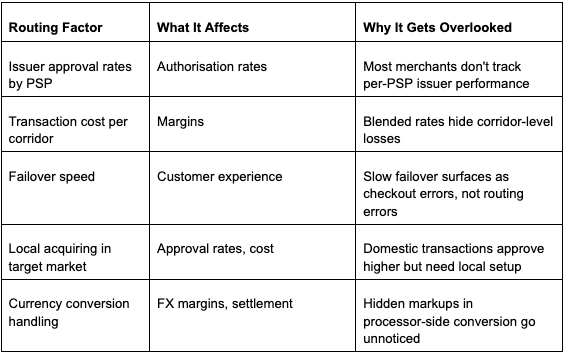
That first row tends to surprise people. Two processors can show nearly identical headline rates and still perform very differently on cards from specific banks. Say 30% of your UK volume comes from Lloyds-issued cards. If Processor B approves those 4% higher than Processor A, you’ve got a payment routing decision hiding in a blended average. You just can’t see it unless you look.
Cost Isn’t Everything, But Ignore It At Your Peril
There’s always someone who wants to route purely on cost. Cheapest processor wins. It’s clean, it’s simple, and it’s usually wrong.
A processor with the lowest fee can also have the worst approval rate for your biggest corridor. You save 2p per transaction and lose £1.50 in failed revenue. Do that a few thousand times a month and the “savings” are actually costing you.
The better question isn’t which processor is cheapest. It’s which gives the best net outcome per transaction type, factoring in approval odds, retry cost, and chargeback risk. Nobody works that out on a napkin. You need a routing layer that acts on live data.
Failover and Routing Aren’t the Same Thing
This gets conflated all the time. Failover says: if this processor goes down, try the other one. That’s disaster recovery. Payment routing says: given what we know about this transaction right now, which processor gives us the best shot? One’s reactive. The other’s proactive. Only one actually moves your numbers.
And how fast your failover kicks in matters almost as much as whether it exists. Eight seconds to detect a failure and reroute means the customer’s staring at a spinning checkout. Most won’t wait. They’ll close the tab, and your analytics will call it an abandoned cart. You’ll never connect the two.
Build to Adapt, Not to Be Perfect
Nobody gets payment routing right on the first try. Processor performance shifts. Issuers change their appetite. Whatever ruleset you launch with is probably wrong within six months.
What matters is whether your system learns. Track approval rates per processor, per corridor, per card type. Adjust weights based on what’s working. Not quarterly. Continuously. The gap between static rules and adaptive ones compounds fast, and for high-volume merchants it lands directly in the P&L.
Beyond Set and Forget
Payment routing isn’t plumbing you set up once and walk away from. It’s a strategic layer, and how you design it shows up in approval rates, processing costs, and whether your checkout holds together when things go sideways. The factors aren’t complicated. But they need attention; they need data; and they need a system that keeps adjusting. Set and forget doesn’t work here. Probably never did.
Disclaimer: This content is for informational purposes only and is not intended as financial advice, nor does it replace professional financial advice, guidance, or recommendations. Always consult with a qualified financial professional before making any financial decisions.