Quick summary: A merchant cash advance (MCA) gives a business fast access to cash in exchange for a share of future sales. It can be approved quickly and with flexible credit requirements, but it is often one of the more expensive forms of business financing. Understanding exactly how it works is essential before signing.
Start With the Vocabulary
MCAs come with their own language. Knowing these terms makes every offer easier to read.
Advance amount – The lump sum the business receives up front.
Purchase price / payback amount – The total the business agrees to deliver to the provider over time.
Factor rate – A multiplier, usually expressed as a decimal such as 1.25 or 1.40, that determines the payback amount. An advance of $40,000 at a 1.30 factor rate means a payback of $52,000.
Holdback (or retrieval rate) – The percentage of daily or weekly sales the provider collects until the payback is complete, often somewhere between 5 and 20 percent.
Split funding – A repayment method where the card processor automatically sends the holdback portion of each batch to the provider.
ACH remittance – A repayment method where the provider debits a fixed amount from the business bank account daily or weekly, based on estimated sales.
Reconciliation – A contract provision that allows the business to request an adjustment if actual sales fall below estimates, so payments better reflect real revenue.
Stacking – Taking a second or third advance while an earlier one is still being repaid.
How an MCA Works, Step by Step
- The business applies, usually sharing several months of bank statements and card processing records.
- The provider reviews sales volume and consistency, often placing less weight on credit scores than a bank would.
- An offer is made, specifying the advance amount, factor rate, and holdback or fixed remittance.
- Funds arrive, often within one to three business days.
- Collection begins immediately, through split funding or ACH debits, continuing until the payback amount is reached.
Legally, many MCAs are structured as a purchase of future receivables rather than a loan. That distinction can affect how the product is regulated and disclosed, and it is one reason owners should read contracts with care.
A Worked Example
Consider a coffee shop that processes about $60,000 in card sales per month.
- Advance received: $30,000
- Factor rate: 1.35
- Payback amount: $40,500
- Holdback: 12 percent of daily card sales
At roughly $2,000 in daily card sales, the provider collects about $240 per business day. At that pace, the payback would take around 169 business days, or about eight months.
The cost of capital is $10,500. That may sound manageable as a flat figure, but when it is expressed as an annualized rate over an eight-month payback period, the effective cost is considerably higher than most bank loans. If the coffee shop has a strong month and repays faster, the effective annual cost rises further, because the same $10,500 fee is paid over a shorter time. Unlike many loans, early repayment rarely reduces the total owed unless the contract specifically offers a discount.
Now consider the opposite scenario. If the shop has a slow season and daily card sales fall to $1,400, the holdback produces only about $168 per day under split funding, stretching repayment closer to a year. That lowers the effective annual cost but keeps a portion of every sale committed to the provider for longer. Under a fixed ACH arrangement without reconciliation, the payment would not fall at all, which can quickly strain the business during a slow stretch.
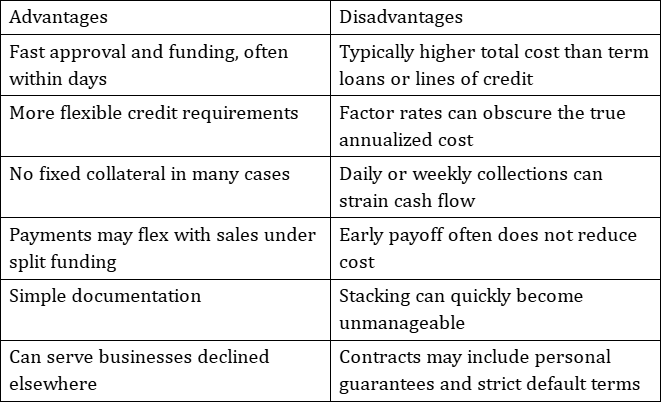
The Trade-Offs Side by Side
Who Commonly Uses MCAs
Merchant cash advances are frequently used by businesses with heavy card sales and limited access to traditional credit. Restaurants, salons, auto repair shops, and retail stores are common examples. They are also used by owners who need funds faster than a bank can deliver, such as when equipment fails or a short-lived opportunity appears.
Owners who want a deeper explanation of how holdback and factor rates interact can find focused educational material at Best MCA Loans. For broader context on how an advance affects daily operations and cash management, resources like Merchant Guidance are useful starting points.
Questions to Ask Before Accepting an Advance
- What is the total payback amount, in dollars?
- What is the estimated annualized cost, given the expected payback period?
- Is repayment collected through split funding or fixed ACH debits?
- Does the contract allow reconciliation if sales decline?
- Is there any discount for early payoff?
- What happens if the business closes or sales drop sharply?
- Does the agreement prohibit additional financing?
- Is a personal guarantee required, and what does it cover?
If a provider cannot answer these clearly, that alone is a meaningful signal.
Research First, Then Apply in One Place
MCA providers vary widely in pricing, transparency, and service. Some offer reconciliation and clear disclosures; others rely on aggressive collection practices. That makes research essential. Read independent reviews, compare how providers explain their costs, and understand the alternatives available for your situation. Comparison and review resources such as Best Rated Business Loans can help you identify reputable providers, while educational sites like Business Loans Blog can help you decide whether an MCA is even the right product, or whether a working capital loan or line of credit might cost less.
Once you have done that homework, apply with the single provider that best fits your needs. Submitting applications to many MCA companies at once is especially risky in this segment of the market. Multiple inquiries can affect your credit profile, and your information may circulate among brokers, leading to a flood of high-pressure calls and competing offers. In that environment, owners sometimes accept advances they do not need or stack several on top of one another, which can quickly consume a dangerous share of daily revenue. A single, deliberate application helps you stay in control of the decision.
When an MCA Might Make Sense
An advance can be a reasonable choice when:
- The need is urgent, and the cost of waiting exceeds the cost of capital.
- The business has strong, consistent card sales.
- The funds will generate a quick and measurable return, such as inventory that sells rapidly.
- Lower-cost options have been explored and are not available in time.
It is usually a poor choice when it would be used to cover ongoing losses, pay off another advance, or fund long-term investments that will not produce returns for many months.
Alternatives Worth Comparing
Before committing, it is worth checking whether a lower-cost product could solve the same problem.
Short-term working capital loans offer quick funding with clearer interest-based pricing, and some allow savings on early payoff.
Business lines of credit let you borrow only what you need and pay interest only on the amount drawn, which can be far cheaper for recurring gaps.
Invoice financing suits businesses that sell to other companies on payment terms, turning unpaid invoices into immediate cash.
Equipment financing is generally more economical for purchasing machinery, since the equipment itself secures the debt.
Business credit cards can cover smaller, short-lived expenses, especially those with introductory offers, as long as balances are paid promptly.
Even if one of these options takes a few extra days, the savings can be substantial.
If You Already Have an Advance
For owners currently repaying an MCA, a few habits help keep things under control. Track daily remittances against your sales so you always know how much remains. Contact the provider promptly if revenue drops, and ask about reconciliation before payments become a problem. Avoid taking a second advance to cover the first, which is how many businesses slide into unmanageable debt. Finally, once the advance is repaid, consider building a cash reserve or opening a line of credit so the next urgent need does not require the same expensive solution.
Final Word
Merchant cash advances fill a real gap in the financing market, offering speed and accessibility that many businesses value. But that convenience comes at a price. Owners who understand the vocabulary, calculate the true cost, research providers carefully, and apply with one well-chosen company can use an MCA as a strategic tool rather than a costly trap. When in doubt, pause, run the numbers again, and consider every alternative before signing.