By: Jean Apachie
There are songs that announce themselves with spectacle, and then there are songs that earn your attention by inviting you into someone else’s experience. Harry Kappen’s “Distant Shore” belongs firmly in the latter category. It doesn’t shout its intentions. It doesn’t chase trends or overwhelm listeners with grand production flourishes. Instead, it unfolds patiently, revealing itself layer by layer until you realize you’ve been drawn into one of the most thoughtful and emotionally resonant independent releases of the year.
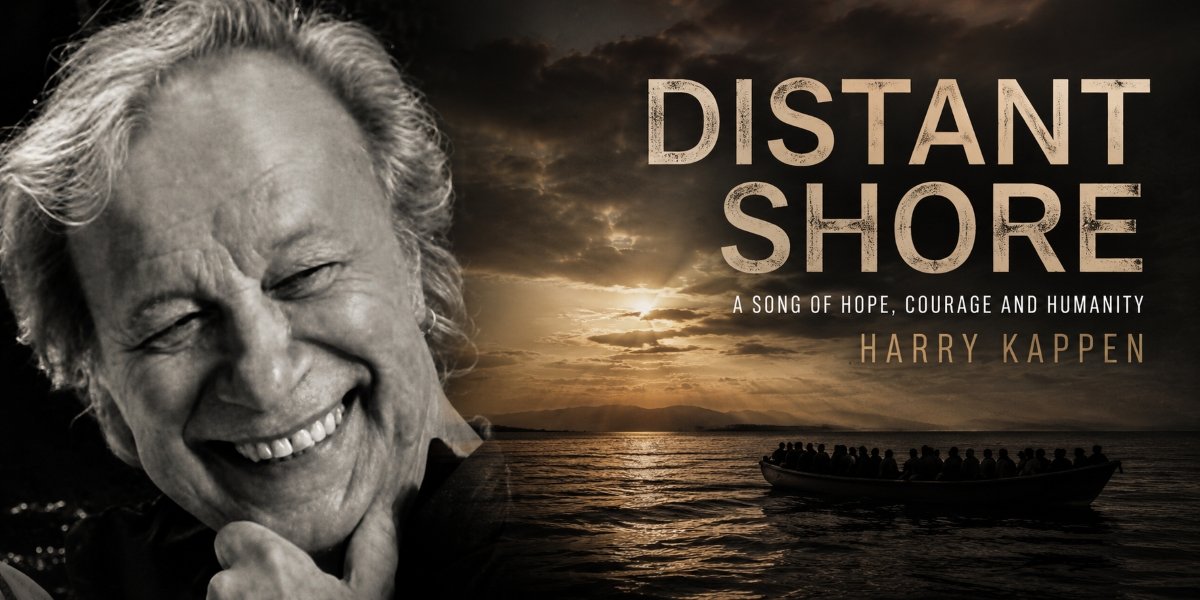
Taken from his album After the Crossing, “Distant Shore” was inspired by the plight of refugees forced to flee their homes in search of safety. It’s a subject that could easily become heavy-handed in less capable hands. Yet Kappen approaches it with remarkable humility. His own move from the Netherlands to Mexico gave him a deeper appreciation for the privilege of voluntary migration, and rather than making himself the story, he uses that realization to shine a light on those whose journeys are born not of choice but necessity.
That perspective shapes every aspect of the song.
The opening lyric, “I kiss the door I can’t replace,” immediately establishes a deeply personal narrative. It’s a simple image, but an unforgettable one. Before there are borders, governments, or politics, there is home. A familiar doorway. A final look around a room filled with memories. Kappen wisely understands that the emotional weight of migration is carried not only by the destination, but by what is left behind.
As the verses unfold, he sketches scenes of crowded trucks, endless travel, crashing waves, and whispered prayers. The lyrics avoid sensationalism, choosing instead to build emotional tension through carefully observed moments. They never feel exploitative because they remain grounded in empathy rather than spectacle.
Musically, “Distant Shore” is equally restrained and effective. Kappen wrote, performed, and produced the track himself, and the result is a remarkably cohesive piece of atmospheric rock. The production is spacious without feeling empty, allowing each instrument room to breathe.
The song’s most distinctive sonic element is its mellotron, an unmistakable nod to David Bowie’s “Space Oddity,” one of Kappen’s acknowledged inspirations. But the influence functions as homage rather than imitation. Bowie’s classic explored the loneliness of isolation in space. Kappen relocates that emotional landscape to the sea, where uncertainty becomes just as vast, and every horizon carries equal measures of hope and fear.
The arrangement moves with quiet confidence. Guitars shimmer gently beneath textured keyboards while understated percussion creates a steady pulse that mirrors the persistence of those continuing forward despite impossible odds. Nothing feels excessive. Every musical choice serves the narrative.
Kappen’s vocal performance deserves equal praise. There’s an honesty in his delivery that immediately establishes trust. He resists dramatic flourishes or unnecessary vocal acrobatics, choosing instead to sing with calm conviction. That restraint becomes one of the recording’s greatest strengths. Rather than instructing listeners how to feel, he allows the song’s emotional gravity to emerge naturally.
The chorus, centered around the repeated question “Where is that distant shore?”, becomes both literal and symbolic. It speaks of physical refuge, certainly, but it also suggests something broader: belonging, security, redemption, perhaps even peace itself. Kappen wisely leaves the answer unresolved. The distant shore remains visible but uncertain, much like hope itself.
What distinguishes “Distant Shore” from many contemporary releases is its emotional maturity. At a time when much of popular music favors immediacy over reflection, Kappen embraces patience. He trusts the atmosphere. He trusts silence. Most importantly, he trusts listeners to engage with complexity rather than offering simplistic conclusions.
His background as a music therapist seems evident throughout the recording. There is an uncommon level of compassion embedded within the songwriting. The song never seeks sympathy for its narrator. Instead, it encourages understanding for others. That distinction elevates “Distant Shore” beyond topical songwriting into something far more enduring.
Throughout his recent creative resurgence (across albums like Escape, Time Will Tell, Four, and now After the Crossing), Harry Kappen has steadily refined an artistic identity rooted in sincerity, craftsmanship, and emotional intelligence. Recognition through awards and international nominations has followed, but those accolades feel secondary to what truly defines his work: an unwavering commitment to writing songs that matter.
“Distant Shore” exemplifies that commitment beautifully.
It is atmospheric without becoming obscure, socially conscious without becoming preachy, and emotionally rich without sacrificing musical elegance. More importantly, it reminds us that independent artists remain capable of creating songs that ask meaningful questions about the world while never losing sight of the individual human heart at the center of every story.
That balance is difficult to achieve.
Harry Kappen makes it sound effortless.