By: Christopher Dunn
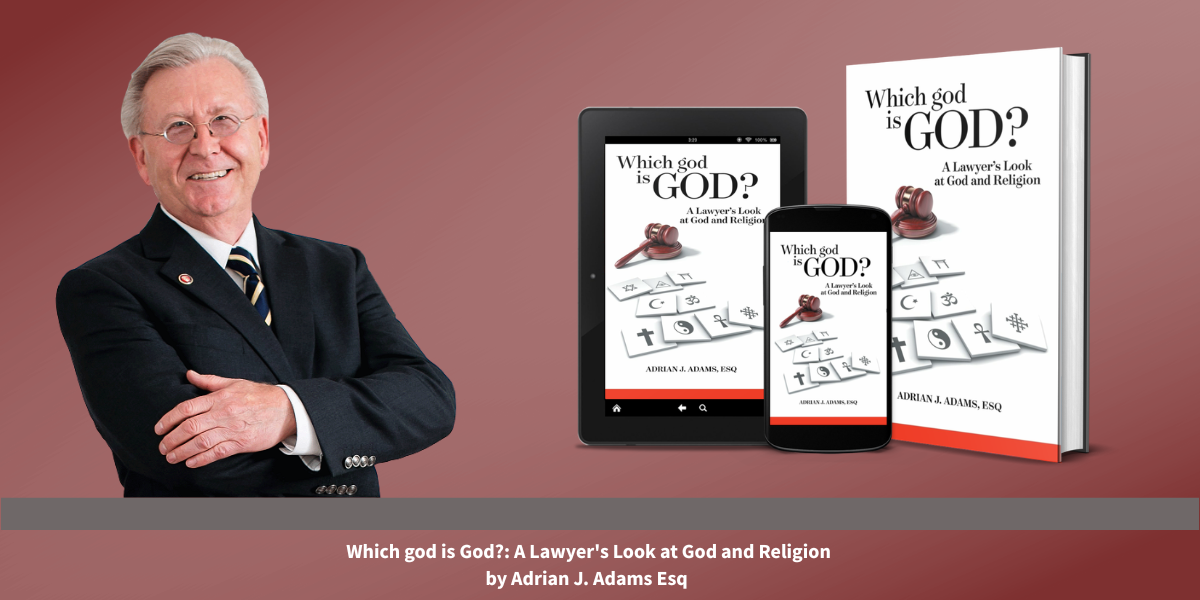
Most conversations about faith drift into emotion pretty quickly. People talk about feelings, upbringing, or tradition. Adrian J. Adams takes a different route entirely. He walks into the discussion like a trial lawyer, not a theologian.
His book, Which god is God?, did not begin as a grand project. It started as a simple exchange between colleagues. Lunchtime conversations with a law partner turned into something sharper. The question was not just whether God exists, but which version of God holds up when examined under pressure.
That shift matters. It moves the conversation from comfort to accountability.
Adrian did not set out to write something abstract. He was answering a very specific challenge. If multiple religions claim authority, how do you test those claims without defaulting to personal bias?
His answer is blunt. You test them the same way you would test testimony in court.
The Case for Evidence in Spiritual Questions
For Adrian, faith is not a blind leap. It is closer to a verdict.
He leans on something most people do not associate with religion: rules of evidence. In his view, belief systems should not get a free pass just because they are ancient or widely accepted. They should be examined, questioned, and, if necessary, dismissed.
That starts with a basic question most people skip. Where does a religion get its information?
In a courtroom, you cannot just make a claim. You need a source. Then you need to prove that the source is reliable. Adrian applies that same pressure to spiritual claims.
He argues that science itself opens the door. Physics, chemistry, biology. The structure of the universe. The idea that something came from nothing does not sit well with him. A beginning implies a beginner. Design implies intention.
From there, the conversation shifts. If a creator exists, then the real debate is not existence but identity.
Faith and Logic Are Not Enemies
Many people assume that faith and logic cancel each other out. Adrian rejects that completely.
He sees them as intertwined. He even points to Albert Einstein, who famously suggested that science and religion are complementary. Science without religion loses direction. Religion without science loses grounding.
That idea runs through everything Adrian writes.
Faith, in his framework, is not about ignoring doubt. It is about working through it with structure. Logic does not weaken belief. It filters it.
At the same time, he is not dismissing personal experience. He is clear that for many people, feeling God’s presence is enough. But he does not stop there. He believes the strongest foundation comes from combining both.
Experience gives belief weight. Evidence gives it durability.
Where Religions Collide
One of the more uncomfortable parts of Adrian’s work is how directly he compares belief systems.
Once he began studying different religions closely, he noticed something most people avoid saying out loud. They do not agree. Not on small details. On core ideas.
The contradictions are not subtle.
Some define God as a personal being. Others describe God as a force, or even as emptiness. Some reject the idea of God entirely. Then there is the afterlife. Some promise it. Others deny it completely.
These are not variations of the same story. They are fundamentally different claims.
Adrian pushes back on the popular idea that all religions lead to the same destination. He sees that belief as convenient rather than accurate. It allows people to avoid making a choice.
Comfort, in this case, replaces clarity.
The Cost of Staying Neutral
There is a tone in Adrian’s thinking that refuses to stay in the middle.
He believes that if you are going to shape your life around a belief system, you should be willing to test it. Not casually. Seriously.
He compares it to a legal case again. When a jury makes a decision, they are not waiting for absolute certainty. They are looking for what holds up beyond a reasonable doubt.
He applies that same threshold to faith.
That means accepting that the outcome might challenge what you already believe. Or what you were taught. Or what feels familiar.
Truth, as he frames it, is not always comfortable. But avoiding it has consequences.
The Role of Personal Experience
Even with all the emphasis on evidence, Adrian does not ignore the more human aspects.
People do not arrive at belief through logic alone.
Some feel something they cannot explain. A presence. A shift. A moment that changes how they see everything. For them, that experience is enough.
Adrian respects that. But he does not treat it as the final step.
He sees belief as something that should be reinforced. Experience might open the door, but evidence keeps it from closing when doubt shows up later.
That combination is what he calls unshakable.
Writing for the Ones Still Searching
Adrian is clear about who he wrote this for.
Not the deeply skeptical who have already decided there is nothing to explore. And not only for those who already believe.
He wrote for people in between.
The ones asking questions. The ones who feel something is missing but do not know where to look. The ones who want more than vague reassurance.
For believers, his work offers structure. A way to understand why they believe what they believe.
For those still searching, it offers a method. Not a conclusion handed to them, but a way to reach one.
A Different Kind of Certainty
Adrian does not promise absolute proof. That is not how courtrooms work, and it is not how he approaches faith.
What he offers is something else. A path to confidence.
A conclusion built on probability, reason, and examination. Not blind acceptance.
He believes that once someone reaches that point, faith changes. It is no longer fragile. It is no longer dependent on circumstances.
It becomes something steadier.
Not perfect certainty, but enough clarity to stand on.
The Bigger Question Still Lingers
His work circles back to a question most people avoid answering directly.
If there is one true God, how would you know?
His answer is not emotional. It is methodical.
Test the claims. Examine the sources. Look for what holds up when challenged.
And then make a decision.
Because in his view, not choosing is still a choice.
For more information, visit his official website at whichgodisgod.com or find his book on Amazon.