Electric vehicle ownership keeps rising across the Dallas area and the smaller communities of Northeast Texas. Many drivers begin with the cord that came in the trunk, plug it into a standard outlet, and wait. That works, but it is slow. A home EV charger changes the daily routine, and the decision involves more than picking a product online. The electrical system behind the wall matters just as much as the hardware on it.
Start With the Electrical Panel
Panel capacity decides what is possible. A home EV charger pulls power from the main service panel, and that panel already feeds the air conditioner, water heater, oven, dryer and every outlet in the house. Texas summers push HVAC loads hard, so headroom that looks fine in November can disappear in July.
A licensed electrician performs a load calculation to measure available capacity. Older homes in the region often run on 100 amp service, while newer builds usually have 200 amps. The age of the panel matters too. Some brands installed decades ago have known safety issues and no longer accept new breakers. If capacity falls short, a panel upgrade or replacement comes before any charger work begins.
Choosing a Charger Level
Charging equipment falls into two practical categories for houses. Level 1 uses a regular 120V outlet and adds a small amount of range per hour. Level 2 runs on 240V, the same type of circuit a clothes dryer uses, and recharges a vehicle faster overnight. The U.S. Department of Energy publishes general charging-speed ranges for both levels through its Alternative Fuels Data Center, and actual results depend on the vehicle, the battery and the equipment.
Most drivers who commute daily choose Level 2 for a home EV charger. Beyond level, three details are worth checking before purchase. Confirm the unit carries certification from a recognized testing laboratory such as UL. Confirm the connector matches the vehicle, since the industry has shifted toward the North American Charging Standard while J1772 remains common. Confirm the outdoor rating if the unit will sit outside, because Texas heat, humidity and storms are real conditions.
Where the Home EV Charger Should Go
Placement affects both cost and convenience. The distance between the panel and the parking spot drives the amount of wire, conduit and labor required. A home EV charger mounted on a garage wall near the panel is simpler than one placed at the far end of a detached garage or along a driveway.
Think about how the vehicle parks. Cable length is finite, and charge-port locations differ by make and model. Mounting height, door clearance and walkway space all deserve a look before anyone drills a hole. Outdoor installations need weather-rated enclosures and proper sealing at every penetration.
Dedicated Circuits and Code Requirements
Charging equipment requires its own dedicated 240V circuit. Sharing a circuit with another appliance is not an option. The National Electrical Code, published by the NFPA, covers electric vehicle supply equipment in Article 625 and addresses continuous load sizing, breaker capacity, wire gauge and GFCI protection. Texas has adopted the NEC statewide, and individual cities adopt specific editions and add local amendments.
Breaker size is matched to the equipment, not the other way around. A 48 amp unit typically calls for a 60 amp circuit because charging is treated as a continuous load. Undersized wire creates heat. Heat creates risk. This is the part of the project where professional judgment protects the house.
Permits and Licensed Work
Cities across the region require an electrical permit and inspection for a new 240V circuit. Caddo Mills, Greenville, Royse City, Rockwall and surrounding jurisdictions each handle permitting through their own building departments, and requirements vary. An inspection record also helps during a future home sale or insurance review.
Texas licenses electricians through the Texas Department of Licensing and Regulation, and license status can be verified through the TDLR public search. Homeowners can ask for a license number directly. A contractor who installs a home EV charger should pull the permit, schedule the inspection and hand over the documentation.
Questions Worth Asking Before Work Begins
A short list keeps the conversation productive. Ask whether the existing panel has capacity for the planned load, and what the load calculation showed. Ask whether a panel upgrade is needed and what that adds in scope. Ask about the circuit size, wire gauge and breaker the installation will use. Ask who pulls the permit and handles the inspection. Ask whether the quote covers materials, labor, permit fees and any drywall or trenching work. Ask about the warranty on labor and how manufacturer coverage on the equipment works.
Clear answers up front prevent surprises later. Vague answers are information too.
Working With a Local Electrician
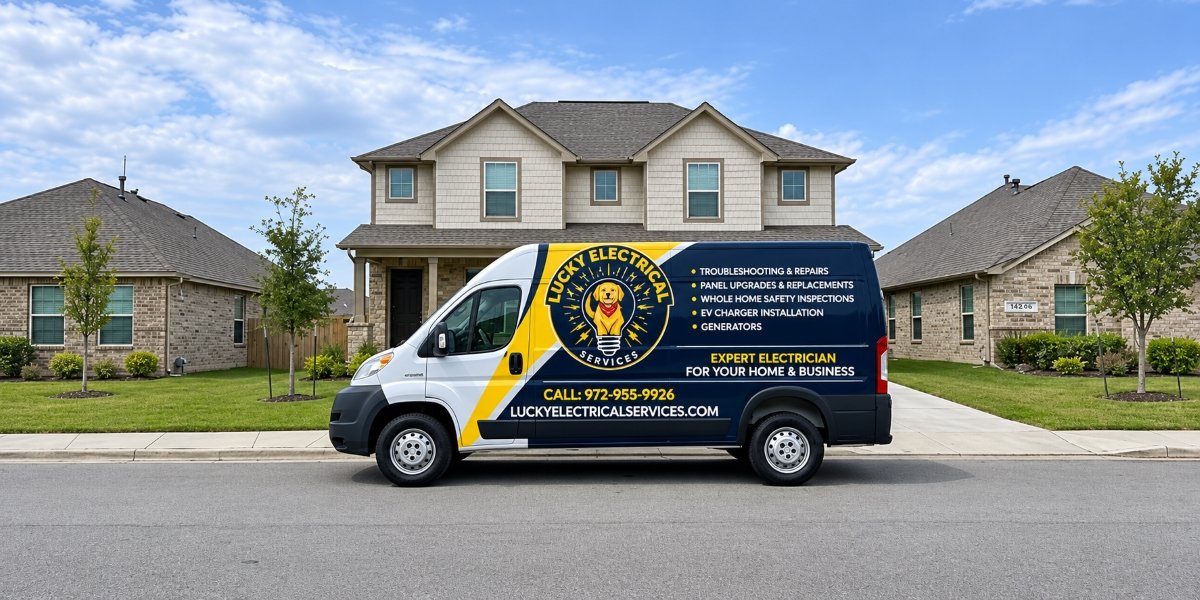
Lucky Electrical is a family-owned electrical services company based in Caddo Mills, Texas, serving homes across Northeast Texas and the surrounding communities, including Greenville, Royse City, Rockwall, Wylie, Farmersville, Fate, Terrell and Quinlan. Residential services include electrical repairs, panel upgrades and replacements, lighting installation and surge protection.
The company’s home EV charger work covers Level 2 installation, dedicated 240V circuits, electrical-panel capacity evaluations and panel upgrades when existing service cannot carry the added load. Clear communication, upfront pricing and code-compliant work shape how the team approaches each job.
Homeowners weighing a home EV charger can discuss panel capacity, placement and permitting with Caddo Mills electrician Lucky Electrical before committing to equipment.
A home EV charger is a long-term addition to a house. Planning the electrical side first makes the rest straightforward.