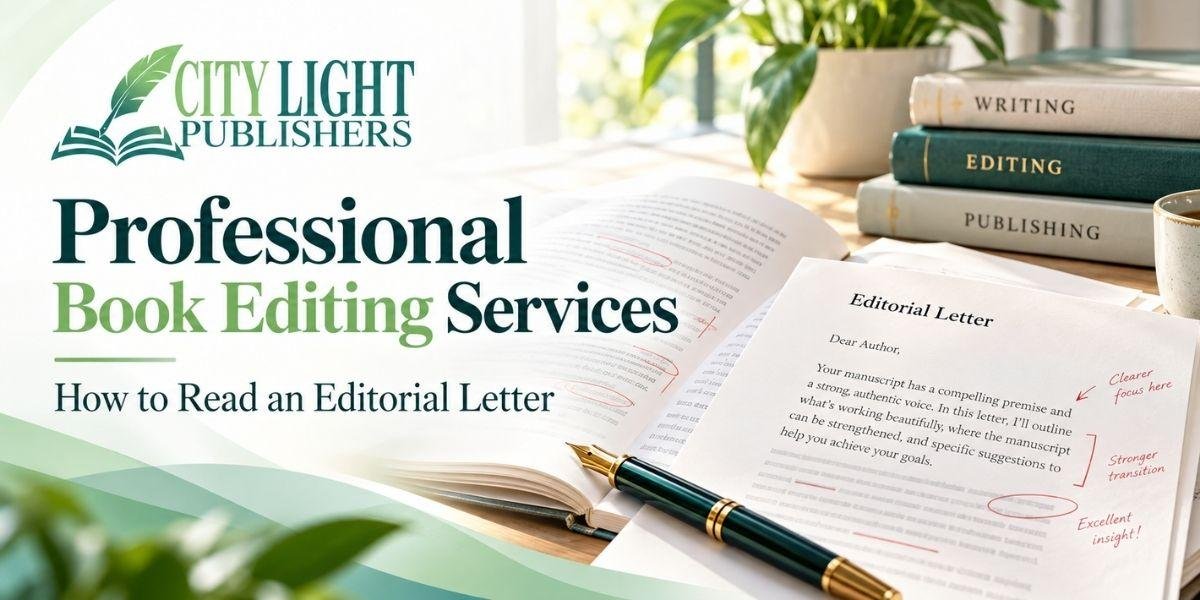
Hiring professional book editing services is about much more than receiving a manuscript filled with tracked changes. One of the most valuable parts of a developmental edit is often the editorial letter that accompanies those changes.
A detailed editorial letter explains what your book is accomplishing, where the manuscript begins to lose strength, what structural problems may be affecting the reader’s experience, and which revisions deserve your attention first.
Many authors immediately open the marked manuscript and start reviewing individual edits. However, this can mean missing the bigger picture. Tracked changes show individual symptoms, while an editorial letter explains the underlying diagnosis.
When used properly, professional editing does more than improve one manuscript. It can also help an author better understand structure, pacing, characterization, argument, and storytelling for future projects.
What Should a Professional Editorial Letter Include?
A strong developmental editing letter should provide more than general praise or a few suggestions. It should give the author a clear understanding of how the manuscript works as a complete book.
Specific Strengths of the Manuscript
Good editors identify what is working and explain why.
For example, an editor may point out that your dialogue communicates character more effectively than your descriptive passages. That observation is useful beyond the current manuscript because it helps you understand your strengths as a writer.
Professional manuscript editing should therefore identify effective elements of the book rather than simply offering encouragement.
A Clear Central Diagnosis
A strong editorial letter usually has a central idea or diagnosis.
The editor might identify that:
- The second act loses momentum because the protagonist stops making meaningful decisions.
- An important argument appears too late in a nonfiction manuscript.
- The strongest part of a memoir has been placed in the wrong section.
- The opening does not properly establish the conflict developed later in the book.
This central diagnosis gives direction to the rest of the manuscript review.
Supporting Editorial Analysis
After identifying the main issue, the editor should explain how it affects other parts of the manuscript.
Depending on the book, the analysis may examine:
- Structure
- Pacing
- Character development
- Point of view
- Argument and supporting evidence
- Opening chapters
- Ending
- Reader expectations
This broader perspective is one of the major differences between developmental book editing and basic grammar correction.
Prioritized Recommendations
Not every editorial problem deserves equal attention.
Effective professional editors prioritize recommendations so authors understand which changes should happen first.
Structural problems should usually be addressed before minor sentence-level improvements because changing the structure may result in entire scenes, chapters, or passages being rewritten or removed.
The editorial letter should also explain what falls outside the scope of the current service so the author knows whether additional copy editing, proofreading, or formatting will be required.
How to Read Editorial Feedback Effectively
Receiving detailed criticism about a manuscript can be difficult, especially after spending months or years working on a book.
The way an author approaches feedback can significantly affect the value received from book editing services.
Read the Editorial Letter More Than Once
Avoid making major revisions immediately after your first reading.
The first response to editorial criticism can be emotional, even for experienced writers. Read the letter once, leave it for a while, and return to it later.
A second reading often makes it easier to evaluate the editor’s comments objectively.
Separate the Problem From the Suggested Solution
An editor may correctly recognize that a scene is not working while suggesting a solution that does not fit your intended direction.
For example, an editor may identify that a scene feels slow and recommend cutting it. The actual solution might instead involve moving the scene, shortening it, changing its purpose, or giving the character a clearer objective.
Take the diagnosis seriously while treating the proposed solution as one possible approach.
This balance allows authors to benefit from professional manuscript editing without losing ownership of their creative decisions.
Pay Attention to the Feedback You Resist
Some editorial comments may immediately make an author defensive.
Those comments are worth examining carefully.
Strong resistance can sometimes indicate that the editor has identified an area the author already suspected might be weak.
Instead of rejecting difficult feedback immediately, consider what the note is pointing toward and whether there is a deeper problem behind it.
When Should You Disagree With an Editor?
Hiring professional book editors does not mean accepting every recommendation.
An editor is an informed reader, but still one reader.
Some recommendations may come from personal genre preferences rather than the intended purpose of the book. For example, an editor unfamiliar with a particular type of horror story may want information revealed earlier, while withholding that information could be essential to the intended tension.
Similarly, recommendations that make a manuscript more conventional should be considered carefully if they remove what makes the book distinctive.
A useful question is:
Can you clearly explain why the recommendation conflicts with what the book is trying to achieve?
If you can explain your reasoning in terms of the manuscript’s purpose, rejecting the recommendation may be justified.
If the only reason is that you personally like the passage, the feedback may deserve another look.
Why the Book Editing Process Should Follow the Right Sequence
City Light Publishers separates editorial work into several stages, including book editing, children’s book editing, proofreading, and formatting.
That separation is important because professional publishing services work best in the correct order.
1. Developmental Editing
Developmental editing services should come first because developmental changes can affect entire chapters, characters, arguments, or sections of the manuscript.
At this stage, editors concentrate on the overall effectiveness of the book.
2. Line Editing and Copy Editing
Once structural revisions have been completed, line editing services and copy editing services can address sentence-level quality, clarity, consistency, grammar, and style.
There is little value in carefully polishing paragraphs that may later be removed during structural revision.
3. Book Proofreading
Book proofreading services should take place when the manuscript is almost finished.
Proofreading focuses on remaining errors such as punctuation, spelling, typographical mistakes, and formatting inconsistencies.
Proofreading before restructuring a manuscript may result in paying to correct passages that are later rewritten or deleted.
4. Book Formatting
Book formatting services should generally happen once the text is finalized.
Formatting too early can create unnecessary additional work when major manuscript changes are introduced afterward.
Following the correct editorial sequence can make the publishing process more efficient and prevent authors from spending money on work that later needs to be repeated.
What Should Authors Ask Before Hiring Book Editing Services?
Before starting an editing project, clarify exactly what the service includes.
Ask what level of editing will be performed and what is excluded.
You should also ask whether the service includes both tracked changes and a detailed editorial assessment letter. The editorial letter explains the reasoning behind major recommendations and can be one of the most useful parts of the entire process.
Authors may also want to ask:
- How many editing rounds are included?
- What happens if additional revisions are required?
- Can the editor provide a sample edit of several pages from the manuscript?
- Does the editor have experience with the book’s subject or genre?
- What will happen after the developmental edit?
A sample taken directly from your manuscript can provide more useful information than a generic before-and-after example.
Why Editor Experience Matters
The right editorial expertise can become especially important when working with specialized books.
City Light Publishers describes its editors as having relevant field expertise and treats children’s book editing services as a separate editorial discipline.
For nonfiction books, subject familiarity can also help an editor judge whether a particular claim requires additional evidence or whether readers in that field would already consider it common knowledge.
Choosing the right professional book editor therefore involves considering both editing skills and relevant subject or genre experience.
Can Editing Software Replace Professional Book Editors?
Modern grammar software can handle many mechanical corrections efficiently.
These tools can identify issues involving:
- Subject-verb agreement
- Punctuation
- Repeated words
- Basic grammatical consistency
What automated tools cannot easily replace is editorial judgment.
Software may correct a sentence, but it is far less capable of determining that a second act has lost momentum, an important concept has been introduced too late, or the most compelling material in a memoir appears in the wrong section.
That deeper judgment is one of the main reasons authors continue to use professional editing services for books.
The Long-Term Value of Professional Book Editing
Editing is usually completed before a book begins generating revenue, which can make it feel like a significant upfront investment.
However, publishing an under-edited book can create problems that are difficult to reverse.
Readers may mention weak writing or editing problems in early reviews. While the manuscript itself can later be corrected and uploaded again, existing reviews may remain attached to the book’s listing.
Working with professional book editing services before publication can help authors identify structural, stylistic, and technical issues while those problems can still be corrected.
A detailed editorial letter is especially valuable because it does more than tell an author what to change. It explains why those changes matter.
By understanding the diagnosis behind editorial recommendations, authors can make more informed revision decisions and carry those lessons into future books.
For authors preparing a manuscript for publication, City Light Publishers provides editorial services covering different stages of the book production process.