By: Marcus Banks
From underground beginnings to chart-topping success, two artists from different corners of Christian hip-hop are demonstrating that powerful beats and an unwavering message can change lives.
Hip-hop has always been about more than music. From its beginnings in the Bronx to its transformation into a global cultural force, the genre has given artists a platform to tell their stories, challenge expectations, and inspire communities. For Christian rappers, that mission carries an additional dimension: using rhythm, rhyme, and personal testimony to communicate a message of faith.
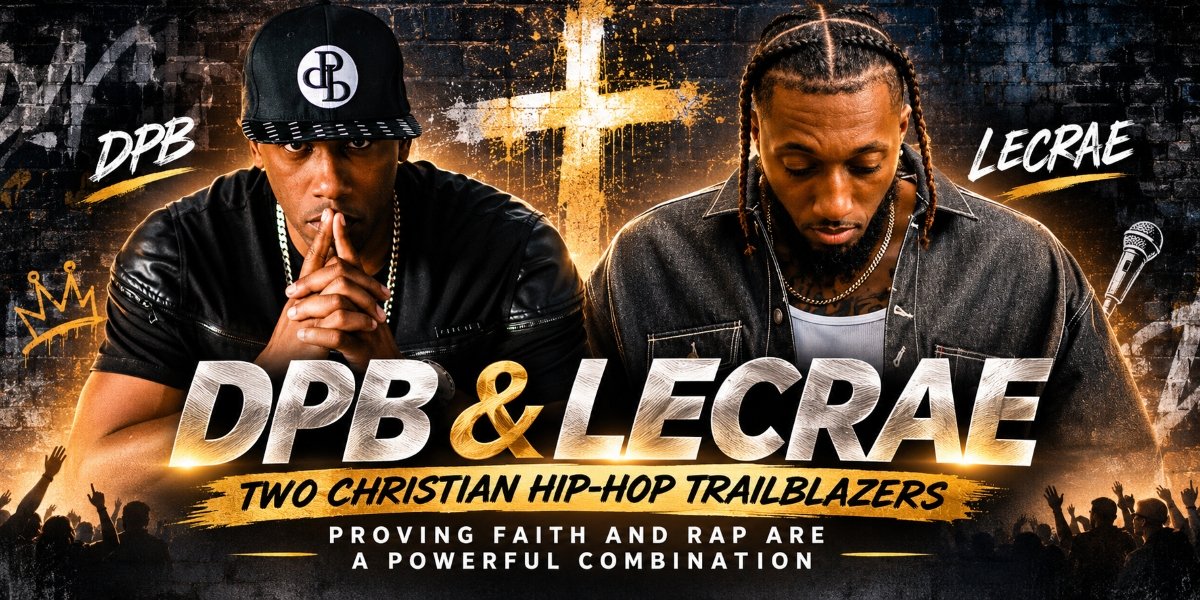
Two artists who embody that commitment are DPB (David Paul Brooks) and Lecrae. Although their careers have followed different trajectories, both have spent decades demonstrating that Christian hip-hop deserves recognition not simply as religious entertainment, but as a legitimate and influential part of contemporary music.
Their stories reveal how perseverance, authenticity, and an unwillingness to compromise can create lasting careers.
DPB: Three Decades of Faith, Music, and Determination
For DPB, music has been a lifelong calling. Born in Nyack, New York, and raised in a family where gospel music was central, Brooks began performing as a child with The Brooks Family. Those early experiences established the foundation for a career combining musical creativity with spiritual purpose.
He eventually became a member of the Grammy- and Dove-nominated Christian rap group D.O.C. (Disciples of Christ), helping introduce faith-centered hip-hop to audiences during a period when the genre was still fighting for mainstream acceptance.
Throughout his career, DPB has shared stages with performers including Salt-N-Pepa, Kirk Franklin, TobyMac, and Bootsy Collins. His work extends beyond recording into motivational speaking, filmmaking, entrepreneurship, and youth outreach.
Now based in Cincinnati, Ohio, DPB continues reaching new audiences through his 2026 album, Undefeated.
Released in March, the project celebrates resilience, personal transformation, and the conviction that life’s greatest challenges can be overcome through faith.
Its singles have generated significant radio attention. “Back in the Day,” a nostalgic celebration of family and formative experiences, reached No. 1 on the National Radio Hits AC40 chart; “God Mode,” meanwhile, climbed to No. 2 on Christian Music Weekly’s Rhythmic Airplay chart.
The latter song takes an intriguing concept from video gaming and transforms it into a declaration of spiritual authority.
Its central message, “Jesus Christ is the God Code,” encourages listeners to recognize the strength they already possess through their beliefs.
DPB is also exploring opportunities to extend the concept into gaming and potentially television, reflecting his determination to connect with younger generations through emerging entertainment platforms.
Lecrae: Taking Christian Hip-Hop Into the Mainstream
While DPB represents the enduring independent spirit of Christian hip-hop, Lecrae has helped demonstrate its extraordinary commercial and cultural potential.
Born Lecrae Devaughn Moore in Houston, Texas, he emerged nationally with his 2004 debut album, Real Talk.
His approach combined contemporary hip-hop production with personal testimony, spiritual reflection, and discussions of the social challenges facing American communities.
Lecrae’s breakthrough came through recordings that refused to separate musical credibility from Christian conviction.
His 2008 album Rebel became the first Christian hip-hop album to reach No. 1 on Billboard’s Gospel Albums chart.
Four years later, Gravity earned a Grammy Award for Best Gospel Album. His 2014 release Anomaly made history by debuting at No. 1 on both the Billboard 200 and Gospel Albums charts.
These accomplishments helped establish Christian hip-hop as a commercially viable force beyond traditional religious audiences.
Through Reach Records, Lecrae has also played an important role in developing other artists and expanding opportunities for faith-based music.
His later work has explored subjects including racial injustice, depression, personal struggles, and spiritual doubt.
Rather than presenting Christianity as a life without difficulties, Lecrae frequently examines the complicated relationship between faith and human experience.
His 2025 album Reconstruction continued that exploration, earning a nomination for Best Contemporary Christian Music Album at the 2026 Grammy Awards. His career now includes four Grammy wins.
Different Approaches, One Mission
What makes DPB and Lecrae particularly interesting is how differently they communicate similar convictions.
DPB often emphasizes encouragement, celebration, spiritual authority, and the power of positive thinking grounded in Christianity.
His music frequently operates as a motivational call to action, encouraging listeners to overcome obstacles and recognize their potential.
Lecrae’s approach is often more introspective, examining personal contradictions, cultural tensions, and the difficulties of maintaining faith in an imperfect world.
Where DPB might encourage listeners to claim victory, Lecrae may explore the struggle required to reach it.
Neither perspective diminishes the other.
Together, they demonstrate the emotional and artistic range available within Christian hip-hop.
Both artists also understand the importance of reaching audiences beyond church walls. Their music engages contemporary culture rather than retreating from it, embracing the sounds, language, and experiences of modern hip-hop.
Inspiring the Next Generation
Perhaps the strongest connection between DPB and Lecrae is their commitment to young people.
DPB has made youth encouragement a central part of his career, combining music with motivational speaking and community engagement.
Lecrae has similarly invested in mentorship, entrepreneurship, and initiatives designed to create opportunities for underserved communities. His work has included participation in programs supporting fatherhood and mentoring.
Both recognize that music can be an entry point into conversations about identity, responsibility, purpose, and personal growth.
Their careers also offer important lessons for aspiring independent musicians: artistic success doesn’t have to require abandoning personal convictions.
A Legacy Still Being Written
Christian hip-hop has traveled an extraordinary distance since its early days of limited distribution and resistance from both religious and mainstream audiences.
Today, the genre enjoys international recognition, major awards, substantial streaming audiences, and increasing influence across popular culture.
DPB and Lecrae have contributed to that progress in different but meaningful ways.
One continues building an independent career rooted in encouragement and spiritual empowerment. The other has helped carry Christian hip-hop into mainstream conversations while challenging expectations about what religious music can address.
There is no need to compare their accomplishments as though one artist’s success diminishes the other’s.
Their collective significance is much greater.
DPB and Lecrae are proof that hip-hop can entertain, challenge, inspire, and communicate faith without surrendering its cultural identity.
And as both continue developing their artistic legacies, they remind listeners that the most powerful music doesn’t merely provide a soundtrack to life.
Sometimes, it helps people discover a reason to keep moving forward.