By: Nicolas Mercado
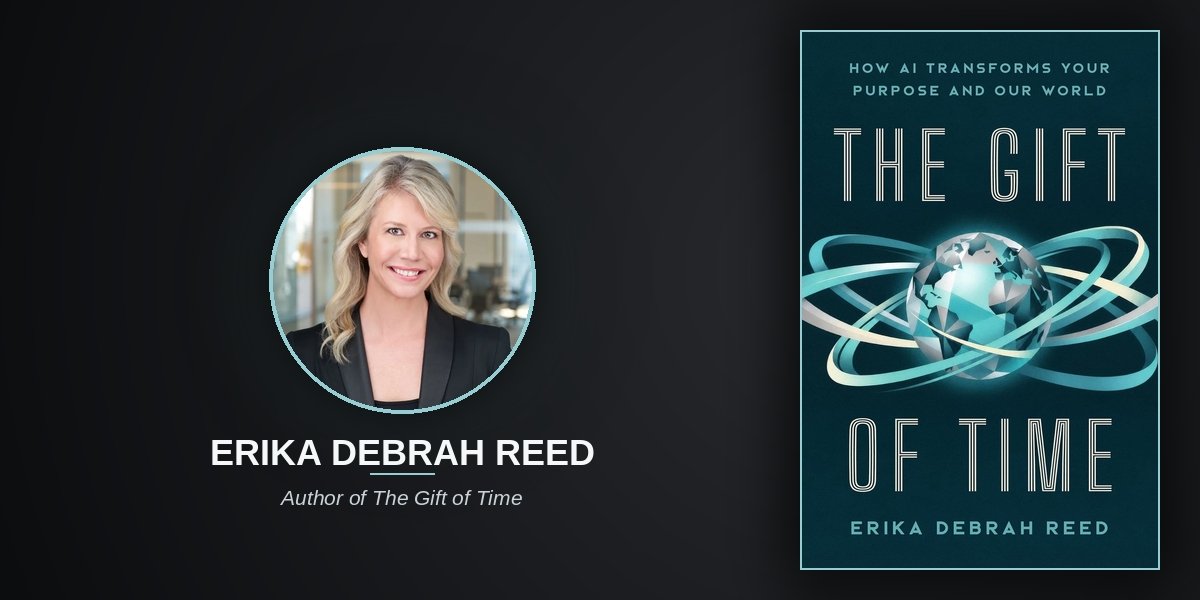
There is a passage in The Gift of Time where Erika Debrah Reed imagines Elena, a freelance architect in 2034, finishing a sketch on her tablet in the back of a multi‑rotor aircraft gliding 1,500 feet above the gridlock of the Los Angeles freeway system, traveling from Santa Monica to the San Bernardino foothills in eighteen minutes, having reclaimed nearly ninety minutes of her life. That passage arrives about halfway through the book and by then Reed has given you enough historical context to understand exactly why it matters: because the story of human civilization is, in significant part, the story of progressively reducing the obligation to spend finite human time on tasks that do not require finite human attention.
Reed traces that story with a range and a specificity that is genuinely impressive. She begins with Plato’s description of time as a moving image of eternity and works through Aristotle’s paradox of the non‑existent present and Augustine’s relocation of time into human consciousness and Newton’s absolute clock and Leibniz’s relational counter‑argument and Kant’s radical proposition that time is a structure of perception and Einstein’s shattering of the universal tick. She moves from ancient sundials and water clocks through mechanical pendulums through the five‑day work week through the washing machine through the elevator operator strike of 1945 through the SABRE airline reservation system through fly‑by‑wire aviation through Knight Rider and the 1982 Pontiac Trans Am through the Tesla neural network through Karel Čapek’s terrified automata through Isaac Asimov’s three laws through the Unimate robot arm through ASIMO through Atlas through Tesla Optimus serving popcorn at a diner.
Each of these is not a detour. Each is an example of the same recurring human project: the attempt to build systems capable of absorbing the repetitive, dangerous, physically exhausting, and administratively consuming labor of daily life so that human beings may redirect finite time toward experiences perceived as more fundamentally human. Reed is not claiming that AI represents something unprecedented in kind. She is claiming that it represents something unprecedented in scale and in speed, and that the question of what human beings will do with the time it returns is therefore more urgent than it has ever been before.
Her writing has the particular quality of someone who has spent her career inside large complicated systems, who knows what it actually takes to predict the future of commerce or work across the intersection of real estate and transportation, and who brings that hard‑won practical intelligence into contact with a deeply humanistic set of concerns about what all of this means for the texture of a human life. The result is a book that is simultaneously intellectually serious and warmly accessible, and that manages the difficult balance of making the extraordinary feel both inevitable and personally relevant.
The Gift of Time is a book worth reading slowly, with the notebook Reed recommends nearby, because it keeps generating questions worth sitting with.
If you want to understand where the current technological transition is actually taking us, not just professionally but existentially, The Gift of Time by Erika Debrah Reed is the most historically grounded, philosophically rigorous, and personally resonant guide available. Grab your copy on Amazon today and start deciding what you will do with the time that is being given back to you.