Same owner, same need, same five working days. On Monday morning, Priya, the fictional owner of Copper Kettle Catering, decides she needs $80,000 for a commissary kitchen expansion. Curious about the difference, she starts two applications at once. Her business is four years old, deposits about $65,000 per month, and she has a 690 personal credit score.
Read each day as a split screen. Everything here is illustrative: timelines and terms vary widely between institutions, and a real application could go faster, slower, or nowhere.
Monday: The Application
At the bank. Priya books a meeting with a business banker she has known for years. He hands her a checklist: two years of business and personal tax returns, year-to-date financials, a debt schedule, a personal financial statement, and a written plan for the kitchen. She’ll need her accountant’s help for half of it.
At the online lender. She completes a form during lunch, links her bank account, and uploads her ID. That takes about 25 minutes. The site tells her that a representative will follow up.
What the split shows. The bank wants evidence of the past few years, while the online lender mostly wants recent cash flow. That difference explains much of what follows. Some of the speed comes from asking for less, and asking for less means pricing in more uncertainty.
Tuesday: The First Real Conversation
At the bank. Her accountant begins assembling the file. Priya’s banker warns that the credit team meets weekly and may ask follow-up questions.
At the online lender. A representative calls with a preliminary range and asks for an extra month of statements. She asks whether she’s speaking to the actual lender or a broker, and writes down the answer.
What the split shows. Asking who actually holds the loan matters more online. Many platforms arrange funding through partners, and that can affect fees and who you’ll deal with later. It’s worth asking a bank too, but the answer is usually simpler.
Wednesday: Numbers Arrive on One Side
At the bank. Nothing yet. Her file is complete, and it’s waiting in a queue. The banker offers an indicative quote, subject to credit approval: 11% for 60 months with a 1% fee.
At the online lender. A written offer arrives, available to her as a qualified applicant: 28% annual interest, repaid weekly over 18 months, with a 3% origination fee deducted upfront.
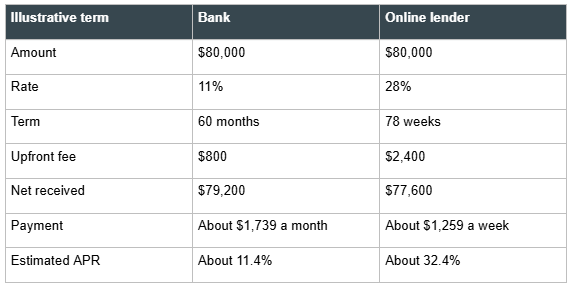
She doesn’t trust her mental math, so she enters both offers in the Fundivi cost calculator for lender offers and checks the output against her own spreadsheet. Any tool is only as useful as the inputs you give it, so she uses the net amount and every fee.
Thursday: The Comparison Gets Interesting
At the bank. The credit analyst requests an explanation of a dip in revenue two summers ago. Priya writes three sentences and attaches a contract list.
At the online lender. The representative says the offer stands through Friday, then calls again to check in. Priya tells him she’ll decide once she has finished her comparison.
What the split shows. Now compare the dollars rather than the rates.
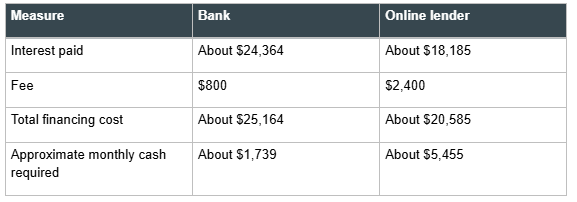
The surprise is that the loan with the much higher rate costs less in total, purely because it ends sooner. Yet that shorter schedule takes about three times as much cash every month. For Priya, $5,455 a month is 8.4% of deposits, compared with 2.7% for the bank loan. The APR says the bank is far cheaper per dollar per year, and that’s still true: she’d have use of the bank’s money for years longer.
Term length explains a great deal of this, so it’s worth watching how term products are being discussed. This Benzinga release on SBA year-end term figures is an example of how lenders link their term loans to government-backed lending data, but it’s worth reading as company news and not as a measure of your own chances.
Friday: Two Very Different Positions
At the bank. Her banker says the file has gone to committee next week. If approved, closing could take another two to three weeks, and a lien on business assets is likely.
At the online lender. The offer is ready for signature. She reads the contract and finds a blanket lien, a personal guarantee, and no interest savings for early repayment.
What the split shows. “Faster” didn’t remove the serious terms. Both options want security. The early-payoff point also matters, because if the full interest is due regardless of when she pays, the attraction of a quick payoff disappears.
What Priya Did on the Weekend
She asked one question: does the kitchen have to be ready by a specific date? Her largest client needs the extra capacity in about ten weeks, so the bank’s timeline works. She waits for the bank.
Had the contract started in two weeks, she might reasonably have paid the premium, because the lost revenue would have outweighed the difference. Before settling, she also reviewed a broader list of small business loans online for 2027 to see whether a middle option existed, such as a credit union or SBA-backed lender.
The Week After the Split Screen Ends
Priya’s comparison would have been incomplete if she’d stopped at closing day, so she thought about what each relationship would look like afterward.
At the bank. There would be annual financial statements to send, and possibly a covenant requiring her to keep a minimum debt coverage ratio. In exchange, she would have a person who knows her business and who might be able to support a later request.
At the online lender. Weekly debits would begin almost immediately and need no attention at all, unless the account ran short. Renewal offers might arrive partway through the term. She made a note to compare any renewal as a new loan, counting the unpaid interest and fresh fees, rather than simply accepting more money.
What the split shows. Ongoing obligations differ as much as the closing process does. Ask either lender what you’d have to report, how often, and what happens if a covenant or a payment is missed.
When Each Side of the Screen Wins
Lean toward a bank when:
- You have time, usually several weeks or more
- Tax returns show consistent profit
- The purpose is long-term and the amount is significant
- You value a local relationship and may want deposits, cards, and credit in one place
Lean toward an online lender when:
- The opportunity expires before a bank could close
- Your history is short or your financials aren’t yet tidy, but deposits are steady
- A smaller amount makes bank paperwork disproportionate
- You’ve tested the frequent payment against your slowest month
Consider a third column as well. Credit unions, community development lenders, and SBA programs can sit between the two. Sites such as SameDayBusinessLoansOnline.com online lender guides can be useful for learning how quick-funding products are structured, whichever side you end up on.
Frequently Asked Questions
Are Online Lenders Always More Expensive Than Banks?
Not always, but their rates generally run higher. Compare the APR and total dollars on your specific offers.
Can a Bank Say No and an Online Lender Say Yes?
Yes, it happens frequently, because the two often use different underwriting standards and accept different levels of risk.
Will Applying at Both Hurt My Credit?
Some reviews are soft and others are hard inquiries. Ask each lender which kind it uses and when it happens.
Is an Online Lender Safe?
Many are legitimate, but verify the company’s identity, read the contract, and never pay an upfront fee by wire or gift card to release funds.
Does Having an Account at a Bank Help?
It often helps, since the bank can see your history. It doesn’t guarantee approval.
Can I Refinance an Online Loan With a Bank Later?
Possibly, once your financials strengthen. Check prepayment terms first, so that you know what the switch would save.
What’s the Biggest Mistake When Comparing the Two?
Looking only at the rate or only at the monthly payment. You need the APR, total dollars, and cash needed each month together.
Disclaimer: This article is for general informational purposes only and does not constitute financial, lending, legal, tax, or investment advice. The examples, figures, rates, calculations, timelines, and scenarios are fictional and illustrative only and do not represent actual offers, terms, costs, or outcomes. Financing requirements, eligibility, pricing, fees, repayment structures, collateral requirements, and approval timelines vary by lender and applicant. Readers should carefully review the complete financing agreement and consult an appropriately qualified professional before making a borrowing decision.