As Texas keeps growing between Houston, Dallas-Fort Worth, Austin, and San Antonio, the state’s most important economic corridor is facing a transportation problem that highways alone may not solve.
Texas has always been a state of distance.
Its cities are large, its highways are long, and its economy moves across wide stretches of road. But inside that scale, one region has become especially important: the Texas Triangle.
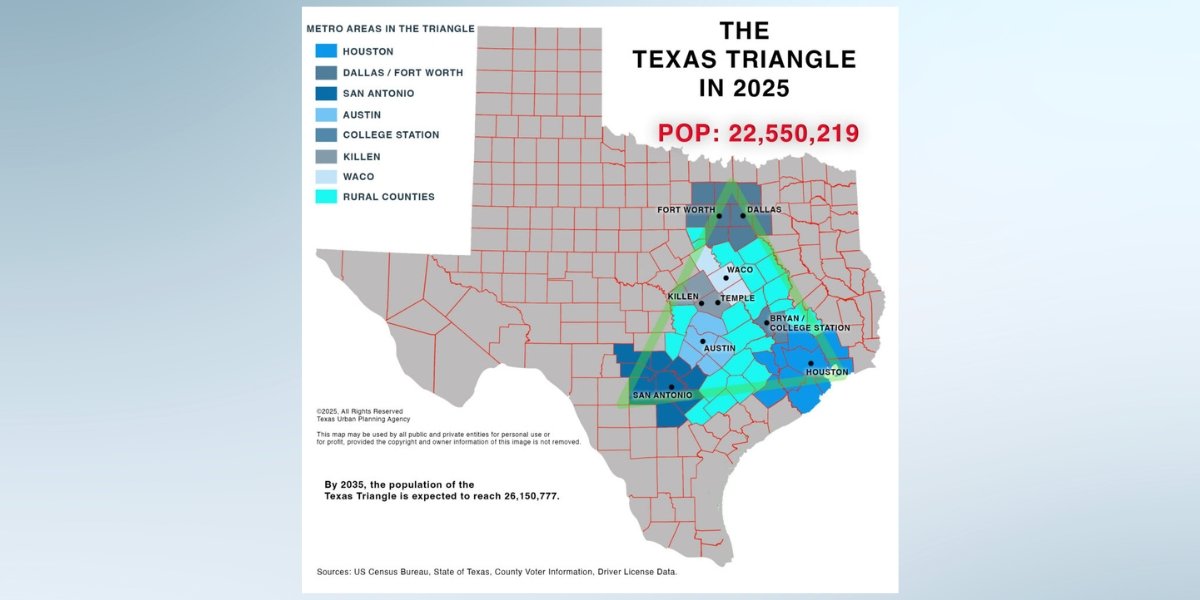
Formed by Houston, Dallas-Fort Worth, Austin, and San Antonio, the Triangle is more than a geographic shape on a map. It is one of the most important megaregions in the United States, connecting population growth, universities, airports, freight corridors, technology hubs, energy markets, health systems, and cultural centers into one fast-moving economic network.
Texas is not growing in one place. It is growing between places.
That is what makes the Triangle so powerful, and also what makes its transportation challenge so difficult. A student in College Station may need to reach Houston for an international flight. A worker in Austin may have family in Dallas. A founder may travel between San Antonio and Houston for meetings. A weekend traveler may move between North Texas and Central Texas. A university applicant, a patient, a tourist, or a new immigrant may need to cross the region without owning a car.
On paper, these cities are connected. In reality, many travelers quickly learn that connection does not always mean access.
The highways exist. The demand exists. The people are already moving. But for many regional travelers, the options between major hubs remain fragmented. Flights can be excessive for short regional distances. Private rides can become expensive. Buses may not match the timing or exact route a traveler needs. Rail has long been discussed, but large-scale passenger rail expansion requires years of planning, funding, right-of-way negotiation, and political coordination.
That leaves a gap in the middle: trips that are too far for local rideshare, too specific for fixed-route buses, too expensive for private car service, and too common to ignore.
The Texas Department of Transportation has recognized the importance of the region through its Texas Triangle Multimodal Strategic Plan, a forward-looking effort focused on the mobility needs of people and goods across the megaregion. The agency notes that the Texas Triangle is home to more than 22 million residents and accounts for nearly 80 percent of the state’s gross domestic product.
Those numbers explain why the mobility question matters. The Triangle is not a side corridor. It is one of the state’s central economic veins.
When transportation between its hubs becomes inefficient, the impact goes beyond inconvenience. It affects workforce access, airport connectivity, university mobility, tourism, logistics, and regional competitiveness. In a state where growth is often celebrated, the next challenge is making sure people can actually move through that growth.
This is where new regional mobility models are beginning to gain attention.
One of the emerging ideas is structured long-distance shared mobility: connecting people who need to travel between cities with drivers already making the same trip. The concept is not new in human behavior. Students, families, and immigrant communities have informally coordinated rides for years through group chats, personal networks, and community referrals.
What has been missing is structure.
Without a trusted system, riders may not know who is driving, when the trip is happening, whether the route is reliable, or whether payment is clear. Drivers may not know if a rider is verified, serious, or safe to pick up. Informal rides solve the problem in small circles, but they do not scale well across a megaregion.
Kamuit, a transportation technology company co-founded by Yogesh Rethinapandian, is one startup working on that gap. The company focuses on scheduled, community-based, long-distance shared rides, especially in corridors where existing transportation options are limited or expensive. Instead of treating every ride as an instant local trip, Kamuit looks at recurring regional routes and tries to organize demand around timing, verification, and shared cost.
“The Texas Triangle already has the roads, the people, and the travel demand,” Rethinapandian said. “The missing layer is coordination. Someone is already driving from one city to another, and someone else needs that same trip. The opportunity is to build a trusted system that connects them before the trip happens.”
That approach reflects a broader shift in mobility thinking. For years, transportation innovation was often framed around urban ride-hailing, scooters, delivery networks, autonomous vehicles, or large public infrastructure. But the Triangle’s challenge sits somewhere else. It is regional. It is recurring. It is practical. And it often exists in the space between public transit and private car ownership.
College towns show the problem clearly.
College Station, home to Texas A&M University, sits within reach of Houston, Austin, Dallas, and San Antonio, but not always within easy access for students and visitors without cars. Many people travel to major airports, family homes, internships, events, or medical appointments across those corridors. The drive may be manageable, but the lack of organized shared transportation can make the journey stressful or expensive.
Similar patterns exist across Texas. Suburbs are expanding. University towns are growing. Airports are serving wider regional populations. People increasingly live, study, and work across multiple metro areas. The state’s economic life is becoming more connected, but its everyday regional mobility options have not fully caught up.
Rethinapandian says Kamuit’s work is shaped by both personal experience and ongoing research into transportation behavior. As a graduate-trained computer engineer and founder, he has worked across systems where trust, coordination, and infrastructure matter. In mobility, he sees the same problem repeated across corridors: people are already moving in parallel, but the system does not help them find each other safely or efficiently.
“Shared mobility is not only about reducing cost,” he said. “It is about making existing movement visible. If thousands of cars are already moving across the Triangle every day with empty seats, then part of the solution may be using that capacity more intelligently.”
That does not mean shared long-distance rides are a replacement for rail, buses, or better public transportation. Texas will likely need all of them. A growing megaregion cannot depend on one solution alone. Better infrastructure, improved transit, airport connections, private mobility services, and technology-enabled coordination can all play different roles.
But the advantage of shared long-distance mobility is speed of deployment. It does not require laying tracks or building a new highway. It starts with behavior that already exists and adds verification, scheduling, routing, and trust.
That makes it especially relevant for a fast-growing state. Texas cannot wait decades for every mobility problem to be solved by major infrastructure. Some solutions will need to be lighter, faster, and more adaptive to real travel patterns.
The Texas Triangle is becoming a test case for that future.
If the region can find better ways to connect its cities, universities, airports, and communities, it can become a model for other American megaregions facing similar problems. If it cannot, growth may continue to place more pressure on roads, families, students, and workers who already feel the cost of distance.
The story of Texas has always involved movement. People move here for opportunity, education, work, family, and a different kind of future. The question now is whether the systems connecting those opportunities can keep up.
The Triangle has the highways. It has the population. It has the economic force.
What it needs next is a smarter way to share the road.