
On a July afternoon in a Houston suburb, a homeowner with a failing air conditioner searches for repair and calls one of the first companies in the map results. A few miles away, an established HVAC contractor with years of satisfied customers never appears in that search. Where it does show up, its listing still carries last year’s hours and a phone number that no longer rings.
Texas has about 3.5 million small businesses, accounting for 99.8% of all businesses in the state, according to the SBA Office of Advocacy’s 2025 Texas profile. For many, local search is where customers are won or lost, and many of those losses can be traced to a handful of common, quiet, and largely fixable local SEO mistakes.
Key Takeaways
- Incomplete or inconsistent Google Business Profile details can cost calls before a customer reaches a website.
- A single page rarely reaches customers across a sprawling Texas metro, and cloned city pages tend to add little.
- Buying or faking reviews now falls under a Federal Trade Commission rule.
- Rankings alone say little about whether local search is producing customers.
- Local search progress typically builds over months, not weeks.
Incomplete Profiles Top the List of Local SEO Mistakes
The most basic problems are also the most common: a Google Business Profile with missing categories, outdated hours or unlisted services, and a business name, address, or phone number that reads differently across directories, review sites, and its own website.
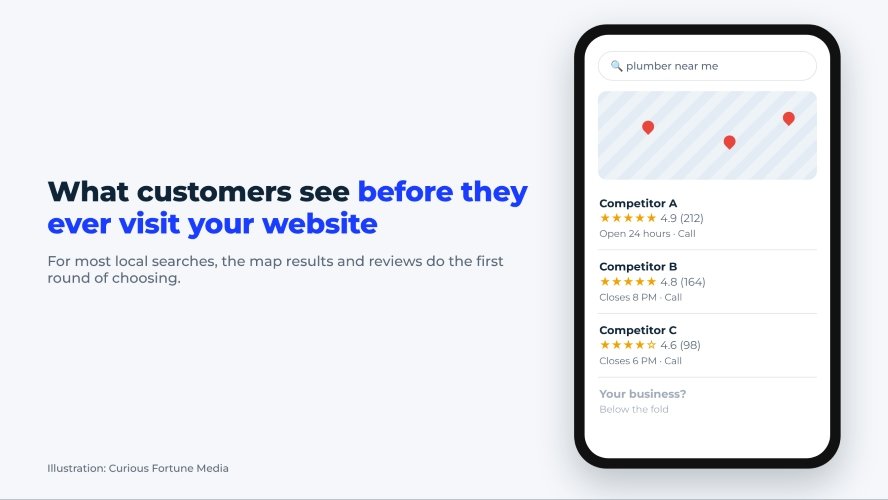
Google’s guidance on local ranking says results are based mainly on relevance, distance, and prominence, and it encourages businesses to keep their information complete and accurate. Inconsistent details can weaken that relevance signal. They also cost customers directly, since many searchers call or request directions straight from the listing without ever visiting a website.
“Plenty of owners treat the listing as a one-time setup,” said Edmond Abramyan, founder of Curious Fortune Media. “But that listing is often the whole first impression. If the hours are wrong or the number doesn’t match, the customer doesn’t investigate. They just call the next name.”
One Page Rarely Covers a Sprawling Texas Metro
Texas metros add a geographic problem. A contractor based in one Houston suburb, Dallas–Fort Worth, or San Antonio may serve customers across dozens of cities yet rely on a single homepage to reach them all. Because Google weighs distance, visibility tends to thin out the farther a searcher is from the business address.
Some Texas small businesses respond with the opposite mistake: dozens of near-identical city pages that swap only the town name. These pages add little for readers. An accurate service area on the business profile, along with a smaller set of pages built around the areas a business actually serves, usually sends a clearer signal.
These fixes often stall when listings, web pages, and reviews are treated as unrelated chores. Abramyan developed the Authority Engine™ at Curious Fortune Media to address that fragmentation. It ties listings, pages, and reviews into three connected layers (visibility, authority, and conversion) so each fix supports the others instead of sitting on a separate to-do list.
Even established brands carry these issues without knowing it. When Abramyan’s agency began working with The Balloon Guy, a Los Angeles luxury event decor company, one of the first steps was a technical cleanup of broken links, duplicate page titles and tracking that wasn’t recording every conversion. Fixing those gave the rest of the work a solid foundation.
Review Shortcuts Now Carry Federal Risk
Reviews are another area where small mistakes compound. Many businesses collect a burst of reviews after opening and then stop, leaving a profile that looks stale to customers who notice how recent the feedback is. Others turn to shortcuts.
In August 2024, the Federal Trade Commission announced a final rule banning fake reviews and testimonials. The agency says the rule covers buying or selling fake reviews, including AI-generated ones; offering incentives conditioned on a positive or negative review; undisclosed reviews from company insiders; and suppressing negative reviews through threats or intimidation.
The alternative is less dramatic: asking real customers for feedback consistently after each completed job and responding to what they write.
Owners Often Judge Results Too Early and by the Wrong Numbers
The last common mistake is how owners measure results. Ranking reports and traffic charts can show steady movement while the phone stays quiet. Calls, form inquiries, direction requests, and booked jobs tend to say more about whether local search is paying off.
Timing matters as well. Owners who expect results within weeks may cancel or switch providers just as earlier work begins to register.
“A ranking report shows movement. Calls and booked jobs show results,” Abramyan said. “When someone quits at the first slow month, they often throw away progress that was still building.”
None of this guarantees a position. Google says local ranking cannot be bought. Results keep changing, including through AI-generated answers, and competition varies widely by metro and trade. Progress is typically measured in months.
Most of these mistakes are basic and fixable, and it’s easy to miss their cost because a lost customer rarely complains. That customer simply calls someone else. Before spending more on marketing, Texas owners may get more from checking the fundamentals: listing accuracy, pages that serve each real market, a steady review habit, and tracking calls instead of rankings. As search engines and AI tools draw on business information from across the web, accuracy and consistency may matter more, not less.
Frequently Asked Questions
What is the most common local SEO mistake?
Incomplete or inconsistent business information, such as outdated hours, missing services, or a phone number that differs across listings, is among the most common and the easiest to fix.
Does a business need a separate page for every city it serves?
Not necessarily. A few substantial pages for the areas a business actually serves are usually more useful than many near-identical pages that change only the city name.
Is it legal to pay for reviews?
The Federal Trade Commission’s 2024 rule bans buying fake reviews and offering incentives conditioned on a positive or negative review.
How long does local search take to show results?
It varies by competition and trade, but meaningful progress typically takes several months, and no one can guarantee a ranking.