By: Cole Harper
Texas has always produced a different kind of country songwriter. While Nashville often rewards immediacy, Texas has long celebrated artists willing to linger in the details, the writers who understand that the best songs aren’t simply sung; they’re lived. From Guy Clark and Townes Van Zandt to Rodney Crowell and Robert Earl Keen, the state’s musical lineage has favored authenticity over artifice. In that tradition, two artists separated by a generation, Radney Foster and Jeremy Parsons, demonstrate that honest storytelling never goes out of style.
Foster, a Del Rio native, emerged in the 1980s as one half of Foster & Lloyd before embarking on a solo career that would establish him as one of country music’s respected craftsmen. Albums like Del Rio, TX 1959, Labor of Love, and See What You Want to See showcased his remarkable ability to write songs that balanced literary sophistication with emotional accessibility.
Hits such as “Nobody Wins,” “Just Call Me Lonesome,” and “Easier Said Than Done” earned Foster commercial success, but his influence extends well beyond the charts. His songwriting has been recorded by everyone from Keith Urban and Sara Evans to Hootie & the Blowfish and Jack Ingram. More importantly, Foster became one of those artists other songwriters studied, not because he chased trends, but because he consistently revealed the humanity inside ordinary moments.
Jeremy Parsons has followed a different path, but one guided by many of the same principles.
Raised in San Antonio, Parsons belongs to a younger generation of Texas artists navigating an independent music landscape transformed by streaming, social media, and direct-to-fan relationships. Rather than pursuing overnight success, he has built his career steadily through relentless touring, consistent songwriting, and a commitment to authenticity.
That persistence has paid dividends. Parsons has earned international recognition through releases like “Tragedy,” which climbed to No. 1 on South Africa’s iTunes Country chart. Songs including “Why Is the Bluebird Blue” have expanded his audience across streaming platforms, while millions of cumulative streams and growing critical recognition have established him as one of the more compelling voices emerging from the Texas Americana scene.
Like Foster, Parsons has never seemed particularly interested in manufacturing a persona. Instead, he has allowed the songs to define him.
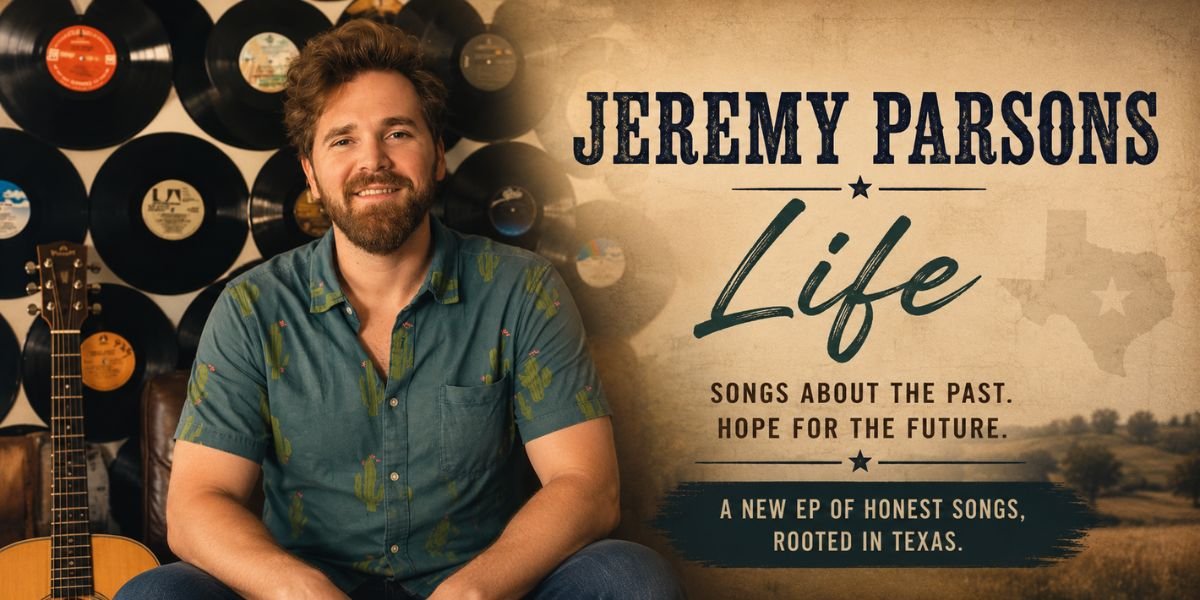
That approach reaches its fullest expression on his recent EP, Life.
Written during the pandemic, the five-song collection examines time, growth, identity, and compassion with remarkable restraint. The opening track, “Tickin’,” reflects on the passing of time without sentimentality. “The Garden,” inspired by Parsons’ father, a horticulturist, transforms gardening into a meditation on emotional resilience. Who Was I revisits his younger years with startling honesty, documenting mistakes without either glorifying or condemning them. The collection concludes with “Life Worth Dyin’ For,” a song that celebrates not perfection but perseverance.
It’s precisely here that Parsons most strongly recalls Foster, not vocally, but philosophically.
Neither artist writes songs that depend on dramatic revelations. Instead, both understand that life’s most significant transformations often occur quietly.
Listen to Foster’s “Closing Time” or “Half of My Mistakes,” then spend time with Parsons’ “Who Was I.” Both writers are fascinated by memory, not as nostalgia, but as education. Their songs don’t attempt to rewrite the past. They seek to understand it.
There’s also a shared generosity in their writing.
Foster has long resisted reducing people to heroes or villains, choosing instead to explore the complicated emotional terrain between those extremes. Parsons adopts the same posture throughout Life. Even on “Humanity,” his critique of contemporary division never becomes accusatory. Like Foster, Parsons approaches people with curiosity before judgment.
Musically, both artists favor arrangements that support rather than overwhelm the lyric. Their voices aren’t defined by technical fireworks but by credibility. You believe them because they sound like they’ve lived the stories they’re telling.
That commitment reflects something deeply Texan.
Texas songwriting has rarely been about vocal acrobatics or polished production. It’s about conversation. It’s about sitting on a porch, around a campfire, or at the back of a dance hall, listening to someone tell you something true.
Foster helped define that tradition for modern audiences. Parsons is helping carry it forward.
While Foster’s catalog spans decades of celebrated albums, songwriting awards, and industry respect, Parsons is still writing the early chapters of his story. Yet what connects them matters more than what separates them. Both have built careers on craftsmanship rather than fashion. Both trust listeners enough to leave emotional space inside their songs. Both understand that vulnerability is not weakness but strength.
In an era increasingly dominated by algorithms and instant gratification, Radney Foster and Jeremy Parsons remind us that some music isn’t designed simply to capture attention. It’s designed to accompany a life.
And in Texas, that’s always been the highest compliment a songwriter could receive.