By: Christian Cooper
Freedom sounds simple until it is taken apart.
For Eugen Ehrenberg, it used to mean something contained. Personal. Local. The ability to live, work, and move within his own world without much friction.
That version of freedom was comfortable. It was also limited in ways he did not notice at the time.
Then life shifted.
And suddenly, freedom was no longer something you assume is there. It became something you fight to understand, rebuild, and protect.
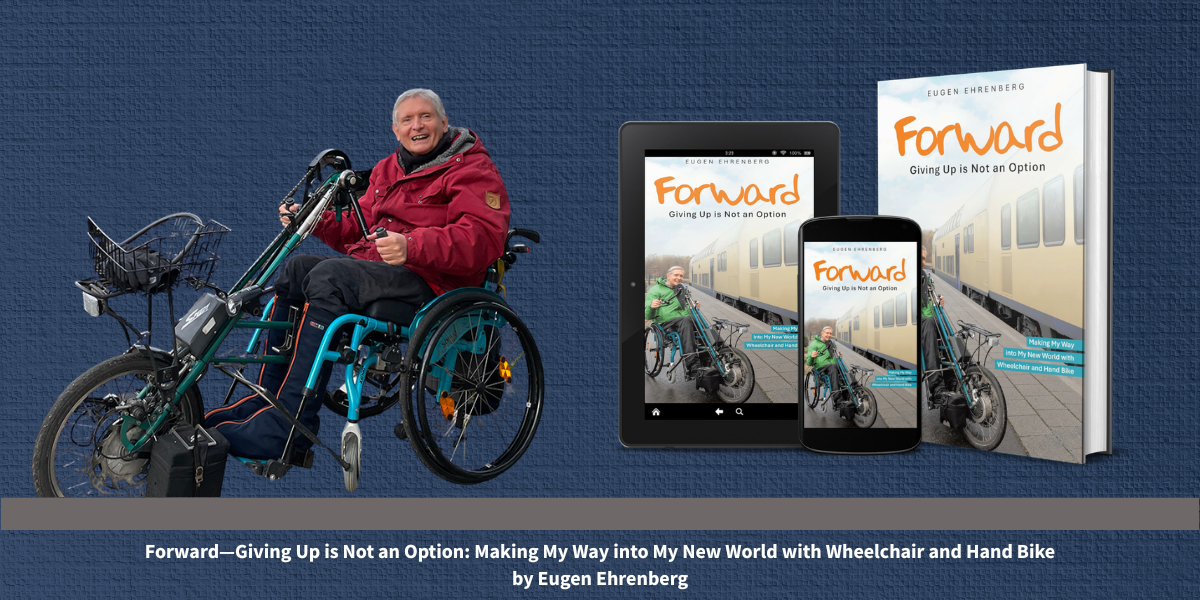
His book Forward—Giving Up is Not an Option is not just about endurance. It is about what happens when your definition of freedom gets rewritten from the inside out.
When Freedom Becomes Personal and Universal
Eugen’s perspective today carries more weight because it comes from loss.
He talks about inner and outer freedom as one of the greatest treasures a person can have. Not just for himself, but for everyone.
That shift matters.
Before, freedom lived inside his own boundaries. His work, his routines, his physical independence. Now, it extends outward. It includes mobility, access, dignity, and the ability for others to live without unnecessary barriers.
You do not arrive at that broader view by thinking about it.
You arrive there by experiencing what happens when those freedoms are restricted.
A Story That Started Smaller Than It Became
Eugen did not sit down to write a manifesto.
At first, he was simply telling stories. Sharing moments from his daily life, the strange, frustrating, sometimes absurd situations he encountered while moving through the world with a wheelchair and hand bike.
Friends found those stories entertaining. Surprising. Sometimes uncomfortable.
That was the starting point.
But as the writing took shape, something else emerged. The story began to stretch beyond personal anecdotes. It started reflecting a pattern. A way of dealing with difficulty that could apply far beyond his own experience.
What began as storytelling turned into something closer to a guide.
Not in a structured, step-by-step way.
More like a lived example of what persistence looks like in real time.
Who This Story Is Really For
At first glance, it is easy to assume this book is for a specific audience.
People in wheelchairs. People dealing with physical limitations. People are facing accessibility challenges.
And yes, it speaks directly to them.
But the feedback Eugen received shifted that idea.
Readers who had nothing to do with mobility issues found something else in his story. They recognized the same emotional patterns. The same moments of doubt, hesitation, and the quiet decision to keep going.
That is when it became clear.
This is not a niche story.
It is about what happens when life forces you into a situation you did not choose and asks you to respond anyway.
The Kind of Impact That Stays With People
Eugen does not talk about impact in abstract terms.
He measures it through specific moments.
A technician who repaired his hand bike read the book and decided to sign up for training. Not because he had to. Because something clicked. If Eugen could push forward under his circumstances, then maybe he could challenge himself, too.
That kind of reaction is not about inspiration in the usual sense.
It is about recognition.
Seeing someone else move through difficulty in a way that makes you reconsider your own limits.
He hears similar things during readings. People walking away with a slightly different posture. A bit more willingness to face what they have been avoiding.
That is the kind of shift you cannot force.
It happens when a story feels real enough to trust.
The Message That Keeps Coming Back
Across everything Eugen shares, one idea keeps surfacing.
Giving up is not an option.
It is not presented as a motivational phrase. It is closer to a boundary condition. A rule that removes one path entirely so that others can start to appear.
When you take giving up off the table, something interesting happens.
Your attention shifts.
Instead of asking whether you can continue, you start asking how.
Solutions that were invisible before begin to show up. Not all at once. Not perfectly. But enough to keep moving.
That does not mean the situation becomes easy.
It means it becomes workable.
A Different Way to Face Crisis
Eugen’s advice for people who feel like their life has been turned upside down is unexpectedly simple.
Sit down.
Take a breath.
Have a cup of hot chocolate.
Sleep.
At first, it sounds almost too basic to matter.
But there is something practical behind it.
When everything feels chaotic, the instinct is to react immediately. To fix, to solve, to regain control as fast as possible.
He suggests the opposite.
Pause long enough to see the situation more clearly.
Give your mind time to settle. Let the emotional spike pass.
Because what looks like a disaster in the moment often reshapes itself after a day or two.
Not because the problem disappears.
Because your perspective changes.
And sometimes, that shift is enough to open a path that was not visible before.
Learning to Laugh Without Denying Reality
There is a detail in Eugen’s approach that stands out.
He leaves room for humor.
Not as an escape. As a tool.
There is something disarming about being able to laugh at a situation that could easily frustrate you. It does not solve the problem, but it changes your relationship to it.
It creates space.
Without that space, everything tightens. Problems feel heavier. Reactions become sharper.
With it, you get a bit of distance.
Enough to think. Enough to adjust. Enough to keep going without carrying unnecessary weight.
What Freedom Looks Like Now
For Eugen, freedom today is not defined by the absence of obstacles.
It is defined by the ability to move through them.
It is internal as much as it is external. A mix of mindset, physical capability, and the willingness to engage with the world even when it does not cooperate.
That version of freedom is harder to build.
But it is also harder to take away.
Because it does not depend on everything going right.
It depends on your response when things go wrong.
Forward Is Still the Only Direction
The core idea behind Forward—Giving Up is Not an Option does not try to simplify life.
It acknowledges that things break. Plans fail. Bodies change. Systems fall short.
And still, movement is possible.
Not always fast. Not always clean.
But forward.
That is the thread that holds everything together.
Not optimism. Not perfection.
Just the quiet decision to keep going, even when the path is unclear.
And sometimes, that is enough to turn a situation that felt like an ending into something that still has room to grow.
For more information about Eugen Ehrenberg and his book, visit Eugen Ehrenberg’s official author website.